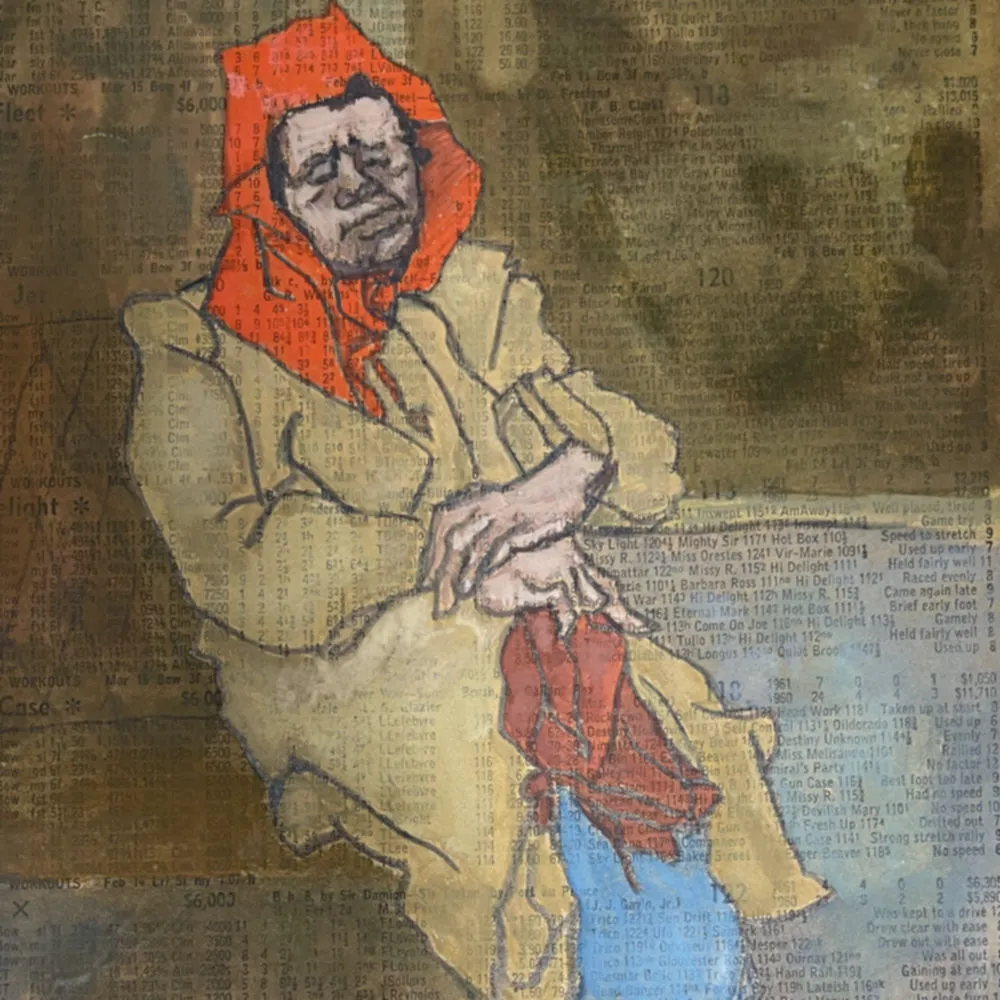
Tom Levine grew up painting. He earned received a BA in English from Miami University of Ohio where he was encouraged to paint his senior thesis rather than write it; this led him to choose a career in art. He also earned an MFA in art history from the University of Cincinnati. Levine moved to New York in 1974, where he waited tables at the Waldorf Astoria and then returned home to paint into the early morning hours. He quit the job after about a year when he couldn’t get three weeks off to mount an exhibition.
Tom’s brother, the conductor James Levine, then offered him a job as an assistant. This job was a good fit for Tom, allowing him time to paint and the opportunity to travel; his interactions with the arts community abroad led to European exhibitions of his work. (Tom’s brother was widely credited for bringing the reputation of the Metropolitan opera house to stratospheric levels, but his career ended in allegations of sexual misconduct; those allegations touched Tom, who was accused of facilitating the abuse.)
Levine’s work, often compared to the work of the minimalist Agnes Martin, exhibits a reductivist style. But he went beyond minimalism to convey a kind of hidden language, an abstracted, perhaps primitive mode of communicating through paint. Muted colors, repetitive patterns, sensual recurring shapes, convey a language that the viewer struggles to understand. He explained, “my mother worked with the National Braille Association, and I would look at the text books for the blind students, and think about those dots, those patterns, how they communicate words without sight. I think what impresses us when we are young, is revealed when we are grown.”
Mr. Levine’s work is held by MOMA, the National Gallery of Art, the Metropolitan Museum of Art, the Whitney, and many others.