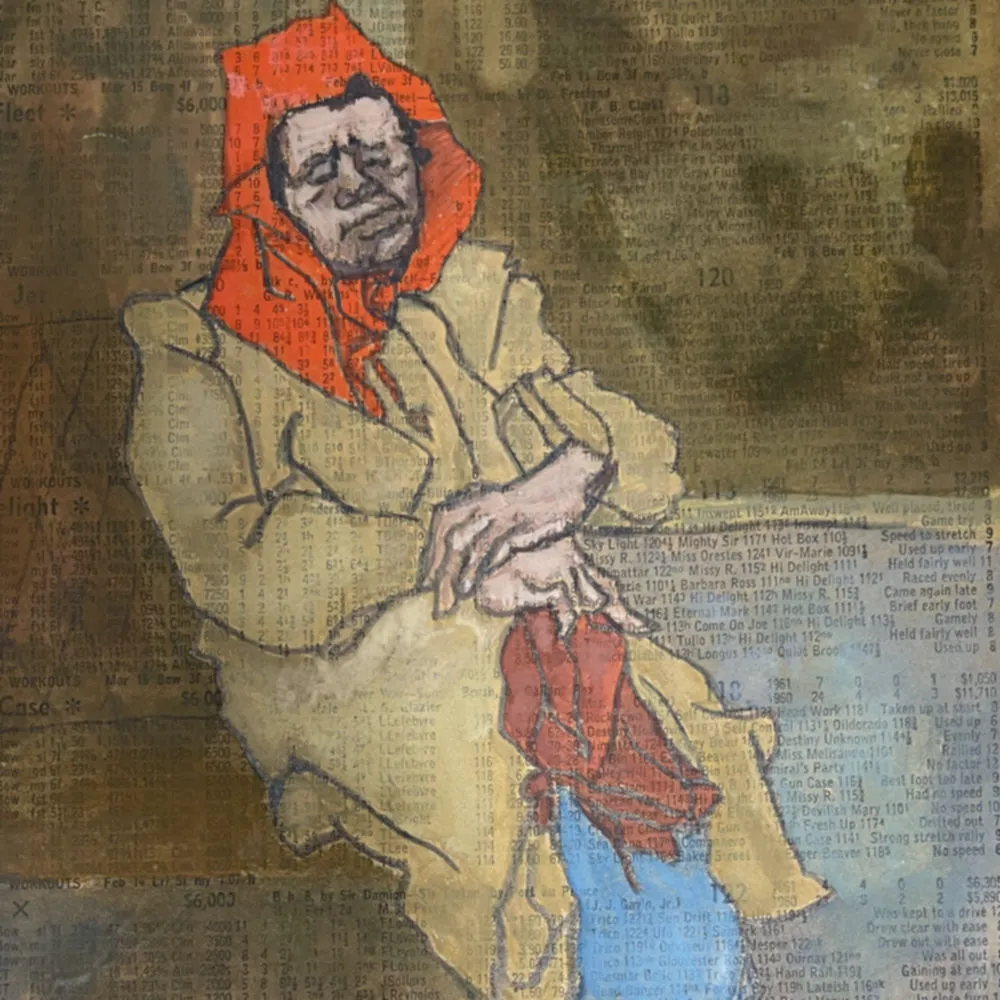
Sarai Sherman was a Pennsylvania-born Jewish-American artist whose work, both in America and in Europe, shaped international views of women and abstract expressionism. She was an important Twentieth Century painter, sculptor, and printmaker.
Sherman showed an early predisposition to painting and her parents enrolled her in an arts and graphics program around the age of ten. These early years began to shape her artistic interests in people, nature, and the built environment. She studied at the prestigious Barnes Foundation, where she was exposed to seminal works of modern masters, and earned a Bachelor of Fine Arts and a Bachelor of Science in education from the Tyler School of Art at Temple University. She decided then, though, that she did not want to teach; she wanted to make art. So she earned a Masters degree in art history and painting from the University of Iowa and then, in about 1948, she moved to New York City.
When she arrived in New York she worked designing fabrics and wallpaper that were sold though stores in Philadelphia and New York. In a United Press International article published in June 1958, Sherman provided a glimpse into her textile and interior architectural design philosophy: “Designers must have a real sense about people and machines or they’ll produce designs which are cultural lags. We must understand the American Women especially, and realize that she is in a state of transition.”
Sherman was awarded a Fulbright Grant to paint in Italy. There she gained a deep perspective into the poverty of postwar Europe. The experiences touched Sherman and became a turning point in her artistic development. For her, Italy became a platform from where she could look and participate in culture completely.
She wrote from Matera in the Spring of 1953:
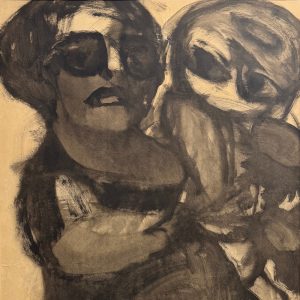
“I feel at home . . . because somehow a passage of light or color, or the motion of an animal, recall to my mind moments of my childhood, distant places. . . . I see a woman with her child in her arms: His small body is in continuous motion, he looks around, he screams. I see mother and child in the sunlight, and it seems to me that I saw them years before, exhausted, yet beautiful. The old image is superimposed in the new one. The painting process is automatic, spontaneous, it leads me. The finished product is all chrome yellow, with ochre hues hovering between white and ivory. They reveal a sense of the ancient.”
Sherman’s conceptual ideas that were expressed in her painting were comparisons between reality and reminiscences, a compelling concern with the world of others, with the dejected southern Italian population and an identification of her own origin within that dejection and that poverty.
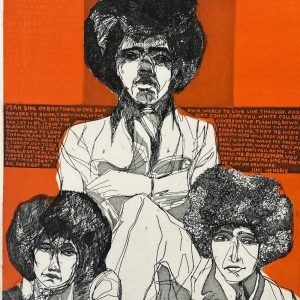
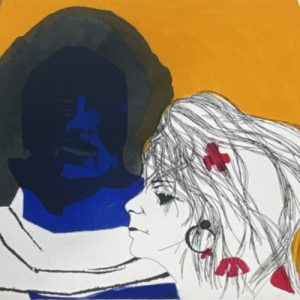
From 1955 to 1960 Sherman worked in the United States. During this period, she amplified the typology and the background of her experiences, weighting the density of her painting. She retracted her steps from Picasso to the Impressionists. Sherman transferred onto her canvas a number of principles of the French masters of the late nineteenth century, filtered through schemes, vision and images, which were neither nineteenth century nor post-romantic in character, largely because internal plastic contradictions of the work and because of her awareness of the dimension of time. The ever-changing spectacle offered by the streets, are elements which have entered her fantasy by force, obliging her to move in a humble effort towards an increased objectivity, but which in the same act of reduction emerge more autobiographical then ever. She also painted popular culture, including paintings of Marilyn Monroe, Jimi Hendrix, and Janis Joplin.
Sherman was represented by the ACA Galleries in New York throughout the 1950s—the only gallery that took women seriously and represented racial and non-White-Americans—and then by the Forum Gallery. She exhibited extensively world-wide.
Sherman’s work is included in numerous private and public permanent collections, including MoMA); the Whitney Museum of Art; the Hirshhorn; the National Gallery of Modern Art in Rome; the Uffizi Gallery, Florence; Jerusalem Museum, Israel; and countless others.